
How to Play Pickleball: A Beginner's Guide
Seven short lessons: the court, the serve, the two bounces, the kitchen, the lines, and how to call the score. Then you can play a game.

Nadia KesslerUpdated 12 min read
In This Story
In This Story
Key Takeaways
- The court is 20 by 44 feet for singles and doubles. The kitchen is the 7-foot zone on both sides of the net.
- Serve diagonally from behind the baseline. The ball must land past the kitchen. A drop serve is the simpler first serve.
- The serve and the return of serve each have to bounce. After that, volleys are allowed outside the kitchen.
- You may enter the kitchen to play a bounce. You may not volley while touching it, and momentum into the kitchen is a fault.
- Usual scoring: only the serving side scores, to 11, win by 2. Doubles starts at 0–0–2.
Pickleball is a paddle game on a small court. Most people play doubles: two against two. You can rally in the first session. The rules that stop a first game are the serve, the two bounces at the start of each point, the kitchen, and a score that has three numbers. This guide teaches those in order. The measurements and faults below are from the USA Pickleball 2026 rulebook. Ask the court which scoring method it uses before you start.
Fast answer
Serve diagonally, let it bounce twice, then stay out of the kitchen to volley
Only the serving side scores in the usual game. Play to 11, and win by 2. Doubles starts at 0–0–2.
Lesson 1. The court is the same for singles and doubles
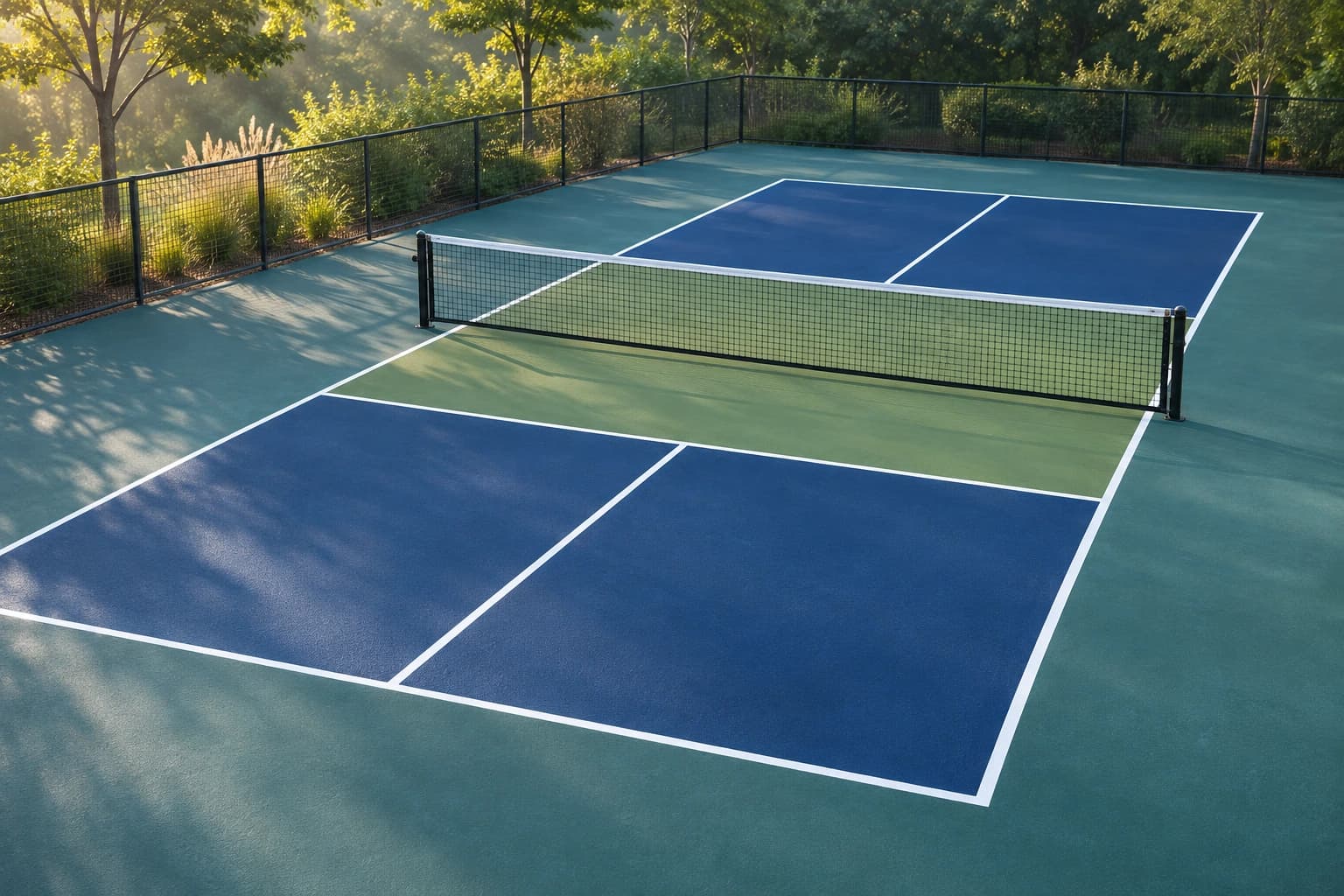
The playing court is 20 feet wide and 44 feet long (6.10 by 13.41 metres). A net crosses the middle. It is 36 inches high where it meets the sidelines and 34 inches high at the centre. The green band in the diagram is the non-volley zone, called the kitchen. It runs 7 feet back from the net on both sides. The lines around the kitchen are part of the kitchen. The centre line splits each end into a left and a right service area.
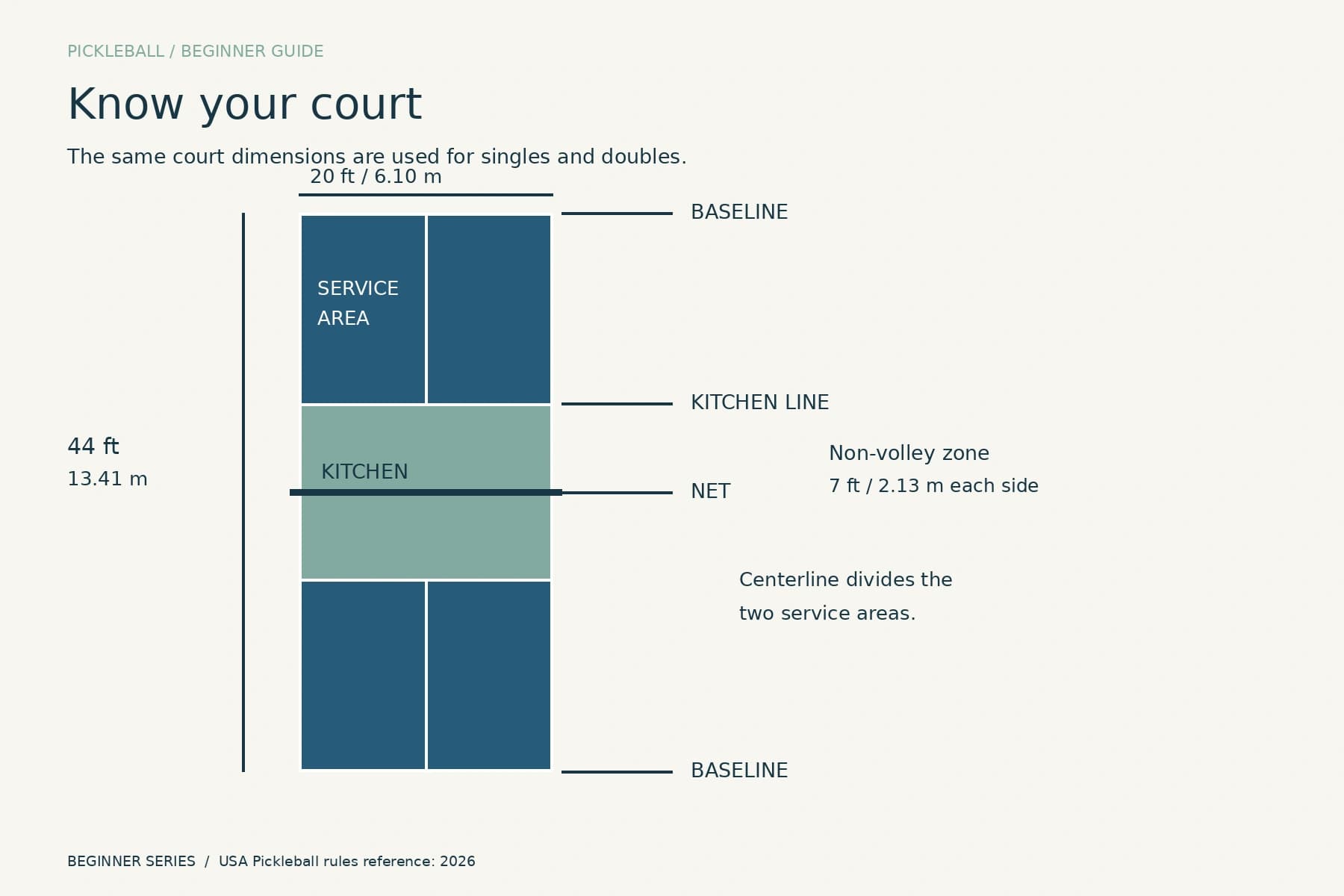
Stand at the baseline to serve. After the opening bounces, most doubles teams walk up toward the kitchen line and play from there. You do not have to stay in one spot during the rally, as long as you stay on your side of the net.
Lesson 2. A paddle and a ball with holes
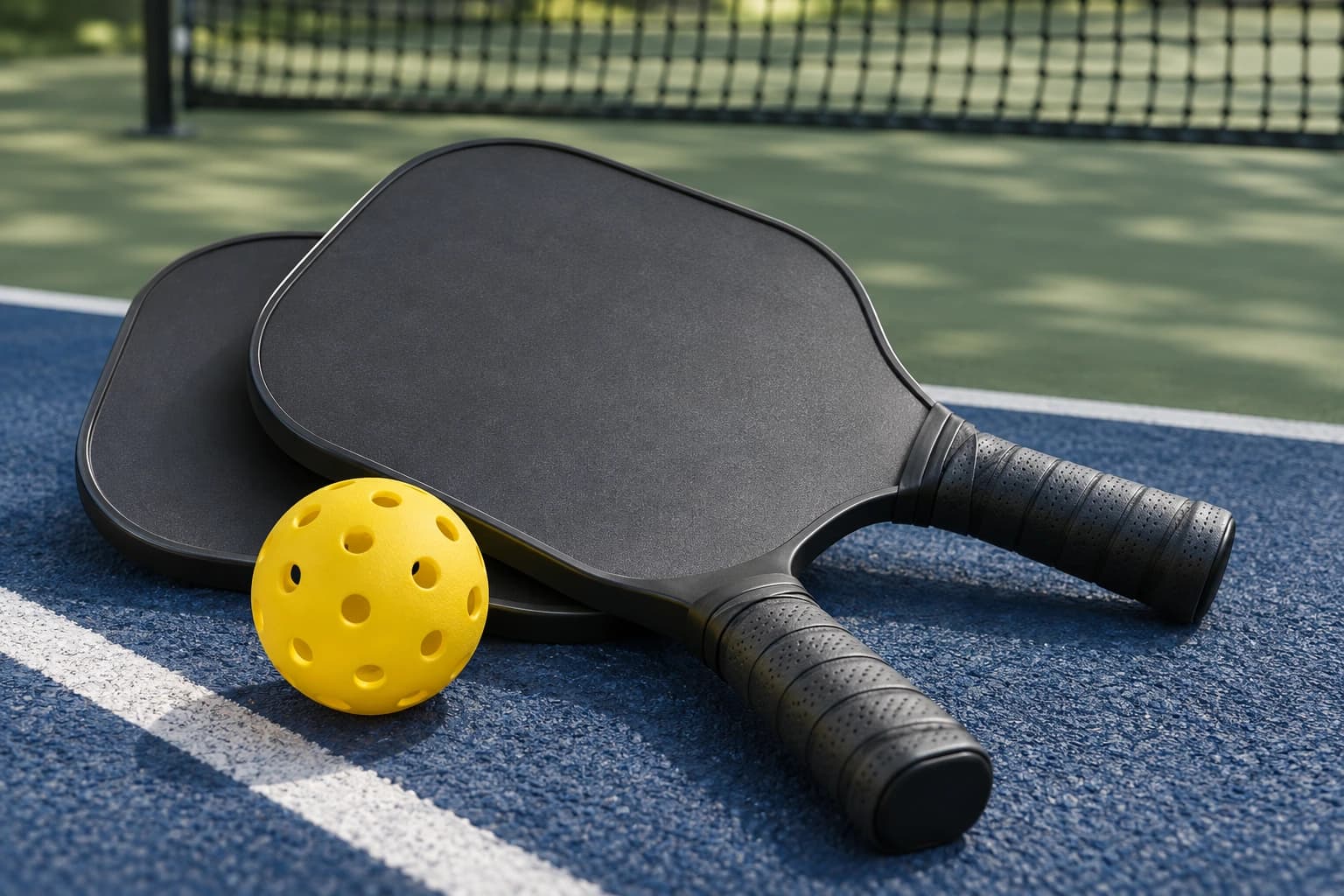
You hit a perforated plastic ball with a solid paddle. There are no strings. Many open-play courts keep loaner paddles, so you can learn the rules before you buy one. Use the ball the court is already using: an outdoor ball and an indoor ball are not the same, and mixing them changes how the point feels. When you do buy a paddle, start with how thickness changes the feel.
Lesson 3. Serve diagonally, and clear the kitchen
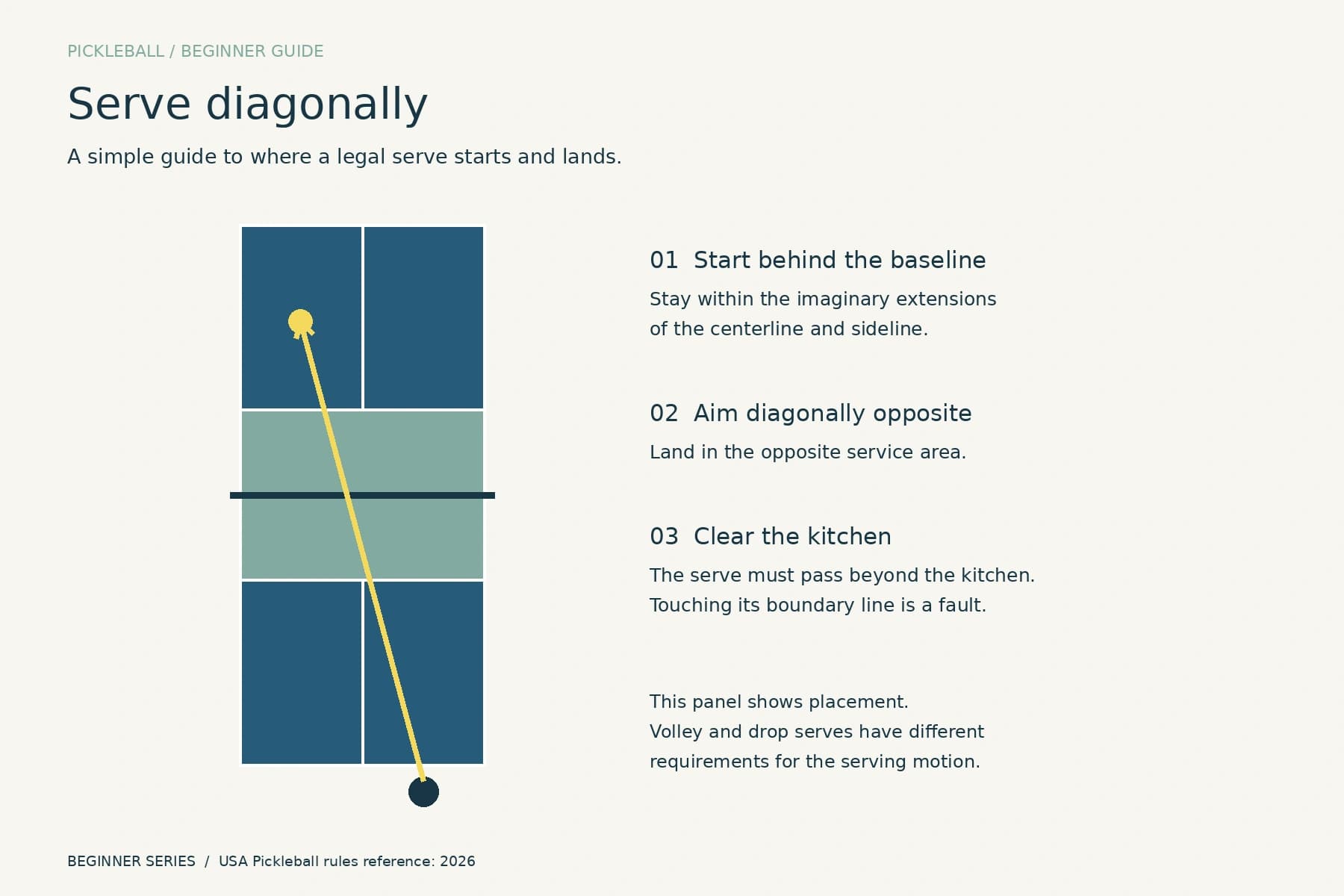
The diagram shows where the serve starts and where it has to land. It does not show every legal way to swing. At the moment you hit the ball, at least one foot is on the ground in the correct serving area, behind the baseline, and neither foot is touching the court or the ground outside that area. Aim diagonally. The ball must go past the kitchen and land in the opposite service area. Touching the kitchen line is a fault. Touching the net is fine if the ball then lands in the right box. You do not get a second serve.
| Compare | Volley serve | Drop serve |
|---|---|---|
| How it starts | You hit the ball out of the air | You drop the ball and hit it after it bounces |
| The swing | Paddle moving upward; paddle head not above the wrist; ball not above the waist | Those three limits do not apply |
| The drop | Released from the hand or the paddle, with no added spin | Released from a natural height, not thrown or pushed |
| Where it lands | Same rule for both: diagonal service box, past the kitchen | Same rule for both: diagonal service box, past the kitchen |
Swipe sideways to see all columns.
If you are new, use the drop serve. Let the ball fall, wait for the bounce, then hit it diagonally. You still have to be behind the baseline, and the ball still has to clear the kitchen.
Lesson 4. Let it bounce. Then let it bounce again
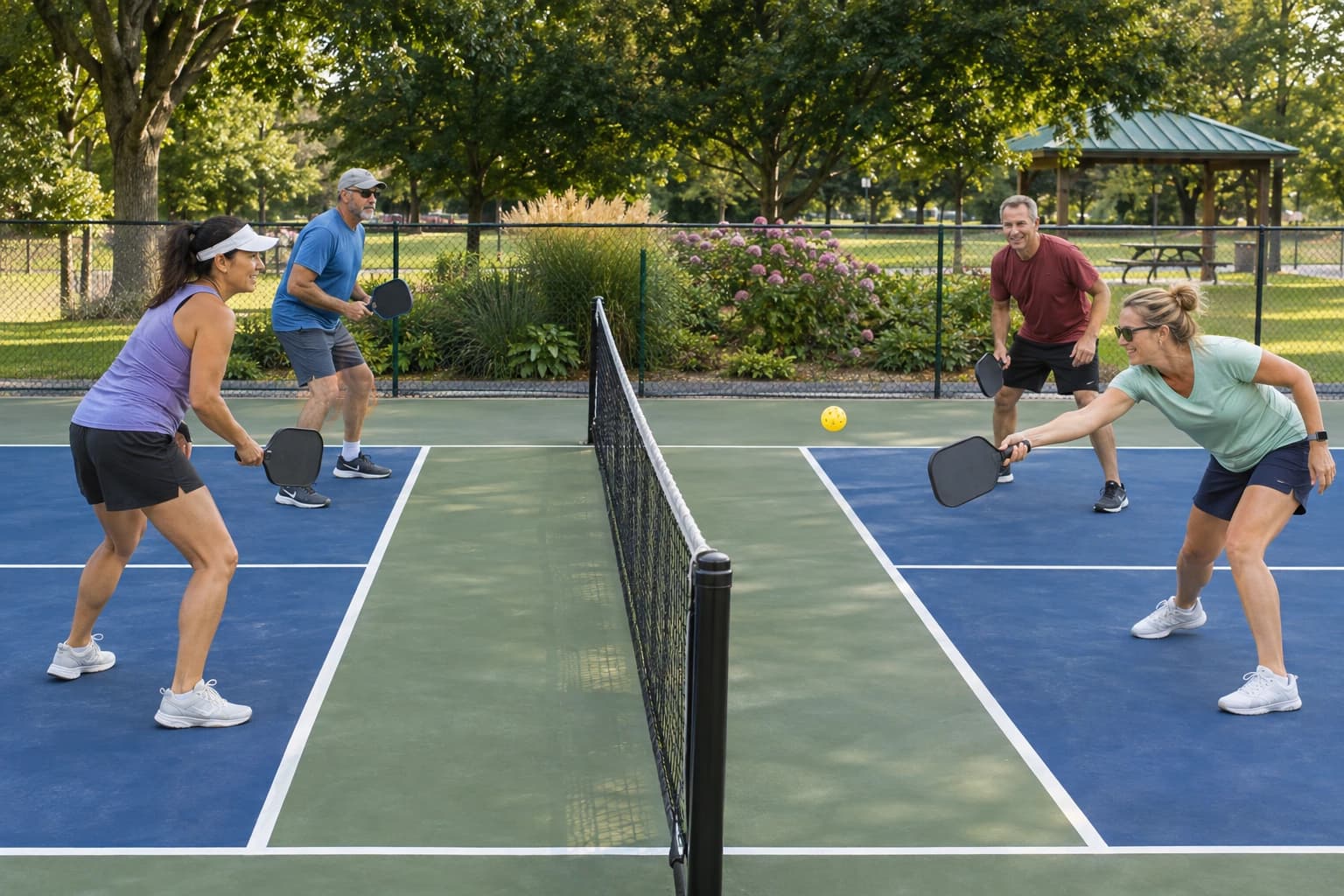
Every rally starts with two bounces, one on each side. The receiving side lets the serve bounce, then hits it. The serving side lets that return bounce, then hits it. After that, either side may volley — hit the ball before it bounces — as long as the player is outside the kitchen. This is why you do not run to the net the instant you serve.
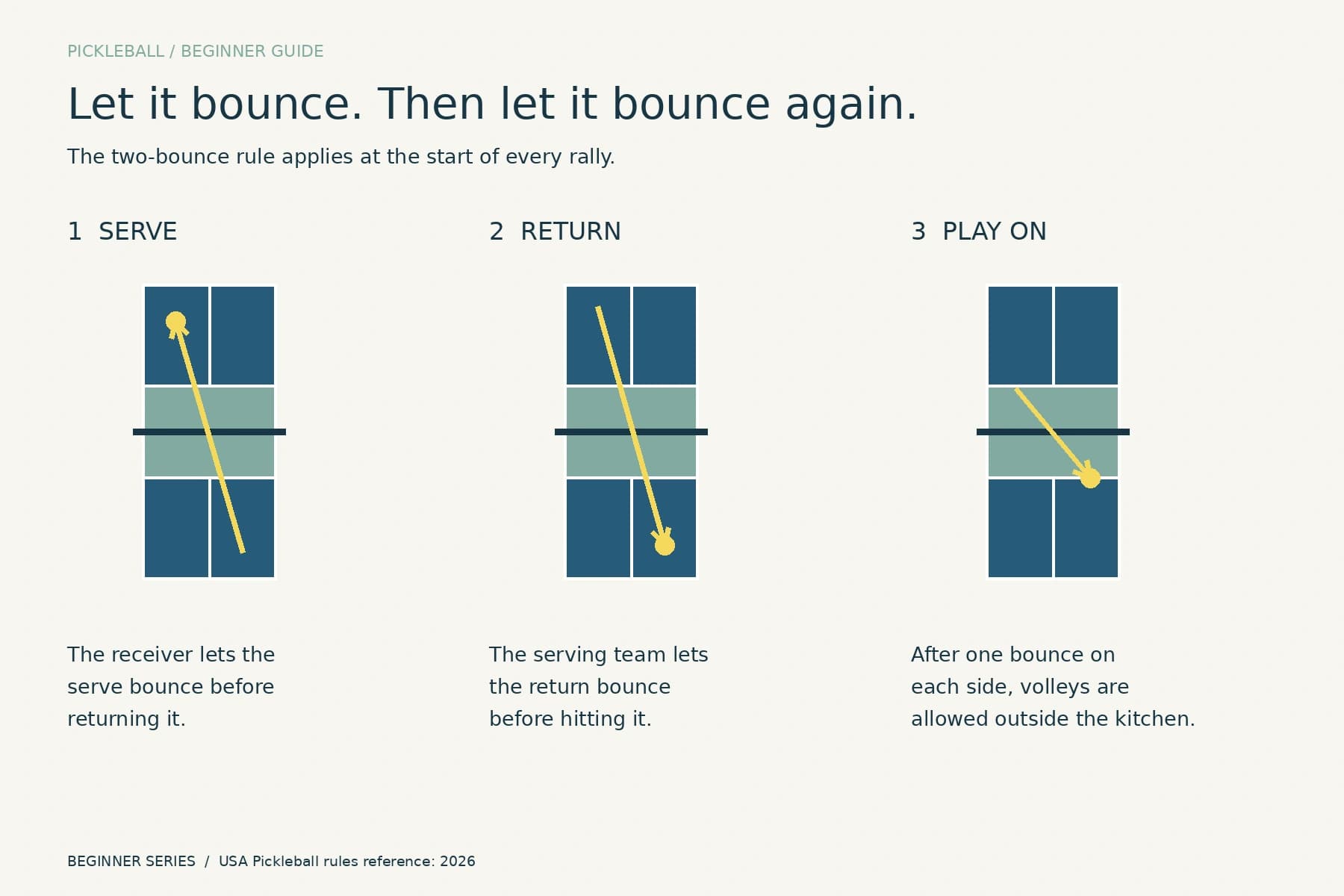
- Serve. The receiver waits for the bounce, then returns.
- Return. The serving side waits for that ball to bounce, then hits it.
- Play on. Volleys are now allowed, outside the kitchen.
Lesson 5. The kitchen is not off-limits
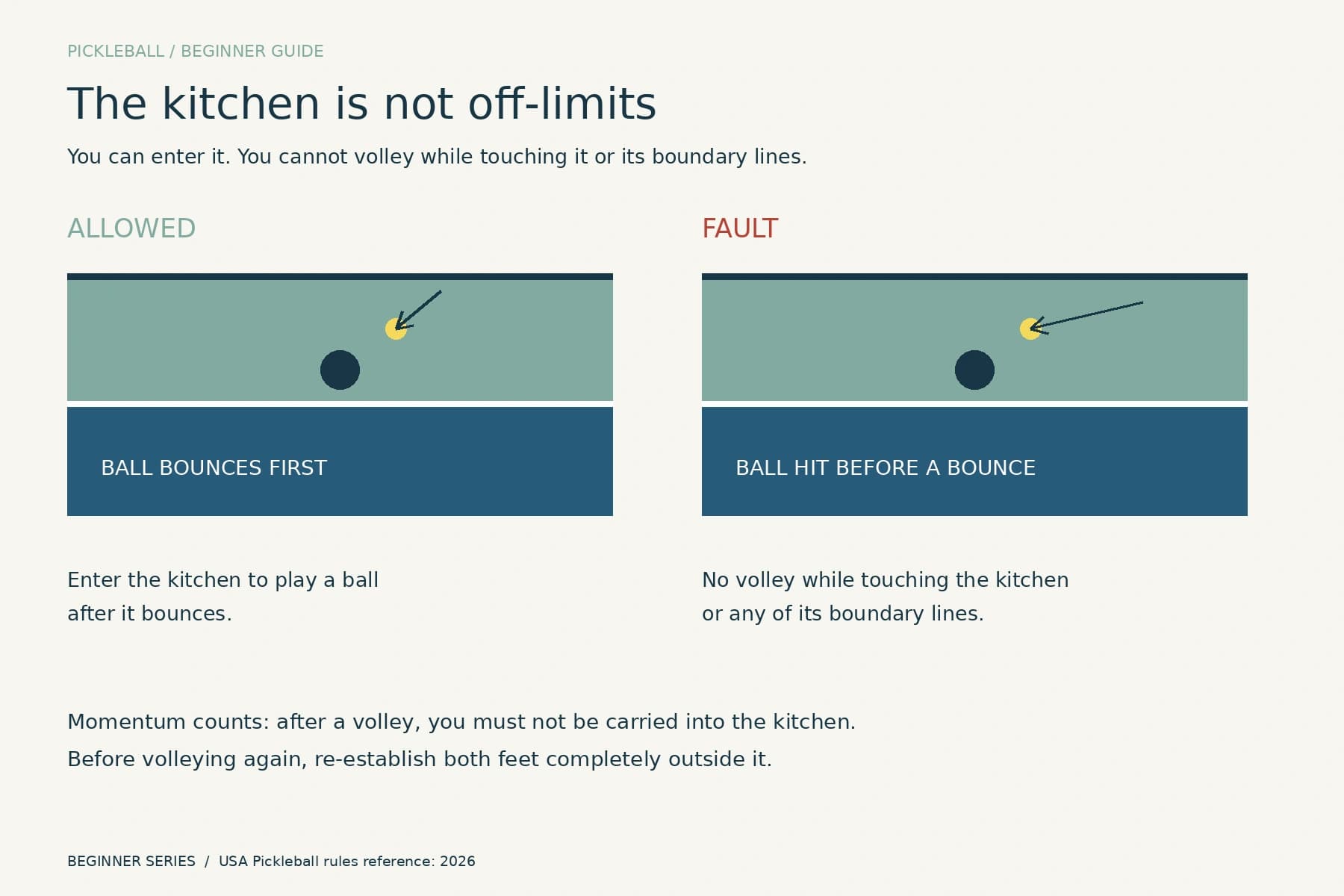
You may stand in the kitchen. You may not volley while you, your paddle, your clothes, or your partner are touching the kitchen or any line around it. If the swing carries you in after the volley, that is still a fault, even if the ball is already dead. To volley again, get both feet completely outside the kitchen first. A ball that has bounced is different: step in and hit it.
Lesson 6. On the line is usually in
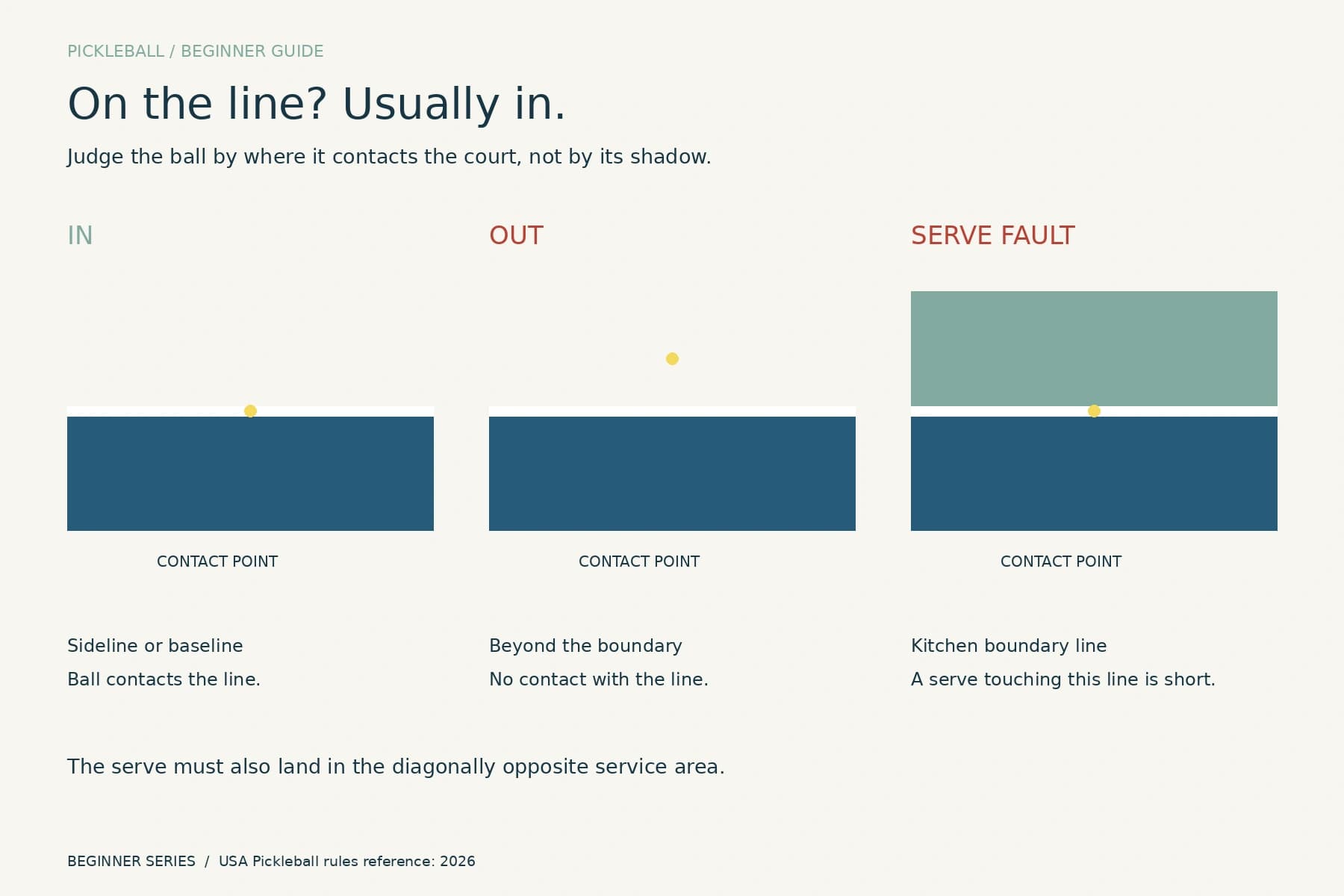
Judge the spot where the ball meets the court, not the shadow. You call the lines on your own end. A ball that touches a sideline or baseline is in. A ball with no contact on the line is out. A serve that touches the kitchen line is short, and that is a fault. If you cannot clearly see the ball out, call it in. If you and your partner disagree, the call is in.
Lesson 7. How to call the score
In the usual game, only the serving side scores a point. The other side has to win the rally and then serve before it can score. Games go to 11, and you must win by 2. Some tournaments play to 15 or 21, still win by 2. Say the whole score, then serve. Hitting while the score is still being called is a fault.
- Doubles uses three numbers: serving side's score, receiving side's score, then server number. A new game is called 0–0–2, because only one player on the first serving side serves.
- After that opening turn, both partners serve before the serve passes across the net. The second number in the call is 1 for the first server and 2 for the partner.
- When your side scores, the server switches sides with their partner and serves again. A lost rally gives the serve to the partner, or to the other team if the partner has already served.
- Singles uses two numbers, your score then theirs, and starts at 0–0. Serve from the right when your score is even, and from the left when it is odd.
Rally scoring is a separate option in the 2026 rulebook. A point is scored on every rally, and the score is two numbers. Only one player serves before the serve changes sides. If a group says it is playing rally scoring, follow that. Do not assume it.
Your first game
- Tell the group you are new, and ask whether the game is side-out scoring to 11 or rally scoring.
- Put a paddle in the queue if the courts are shared. Wear court shoes and something with a pocket for the spare ball. The outfit guide covers the rest.
- Call the score. Serve from behind the baseline, diagonally, past the kitchen.
- Wait. The return of serve has to bounce on your side before you hit it.
- Play the kitchen as a place you can enter for a bounce, not a place you can smash from.
- Call your own lines. On the line is in. If you are not sure, it is in.
A short warm-up is worth more than a harder serve. If you are still choosing a sport, pickleball, padel, and tennis are not the same game.
Frequently Asked
How do you play pickleball for beginners?
Serve diagonally from behind the baseline into the opposite service box, past the kitchen. The receiver lets the serve bounce. The serving side lets the return bounce. After those two bounces, both sides may volley from outside the kitchen. In the usual game only the serving side scores, to 11, win by 2.
What is the kitchen in pickleball?
The kitchen is the non-volley zone, 7 feet on each side of the net. The lines around it are part of the zone. You can stand in it and play a ball that has bounced. You cannot volley while touching it, and being carried in after a volley is a fault.
What is the two-bounce rule in pickleball?
The receiving side must let the serve bounce before hitting it, and the serving side must let that return bounce before hitting it. After one bounce on each side, players may hit the ball in the air, outside the kitchen.
How do you serve in pickleball?
Stand behind the baseline in the correct serving area and hit diagonally into the opposite service box, past the kitchen. A volley serve must move upward, with the paddle head not above the wrist and the ball not above the waist. A drop serve is hit after the ball bounces, and those three limits do not apply. You get one serve.
Is a pickleball on the line in or out?
If the ball touches a sideline or baseline, it is in. If it does not touch the line, it is out. A serve that touches the kitchen line is a fault. Call the lines on your own end, and if you cannot clearly see the ball out, call it in.
How does pickleball scoring work?
In traditional side-out scoring, only the serving team scores. Games are to 11, win by 2. Doubles is called as three numbers and starts at 0–0–2. Singles is two numbers and starts at 0–0. Rally scoring, where every rally is a point, is a separate option.
Why does pickleball start at 0-0-2?
At the start of a doubles game only one player on the first serving team gets a serve. Calling that player server 2 keeps the rest of the rotation even. After the first side-out, both players on a team serve.
Sources
The Weekly
Movement, wellness, longevity and what we’re wearing — plus who’s moving on the athleisure ranking.
No spam. Just the good stuff.
By joining, you agree to our privacy policy.
Keep Reading


